
40 Years a Radical
Why non-violent action feels like a suggestion I’m ready to ignore.

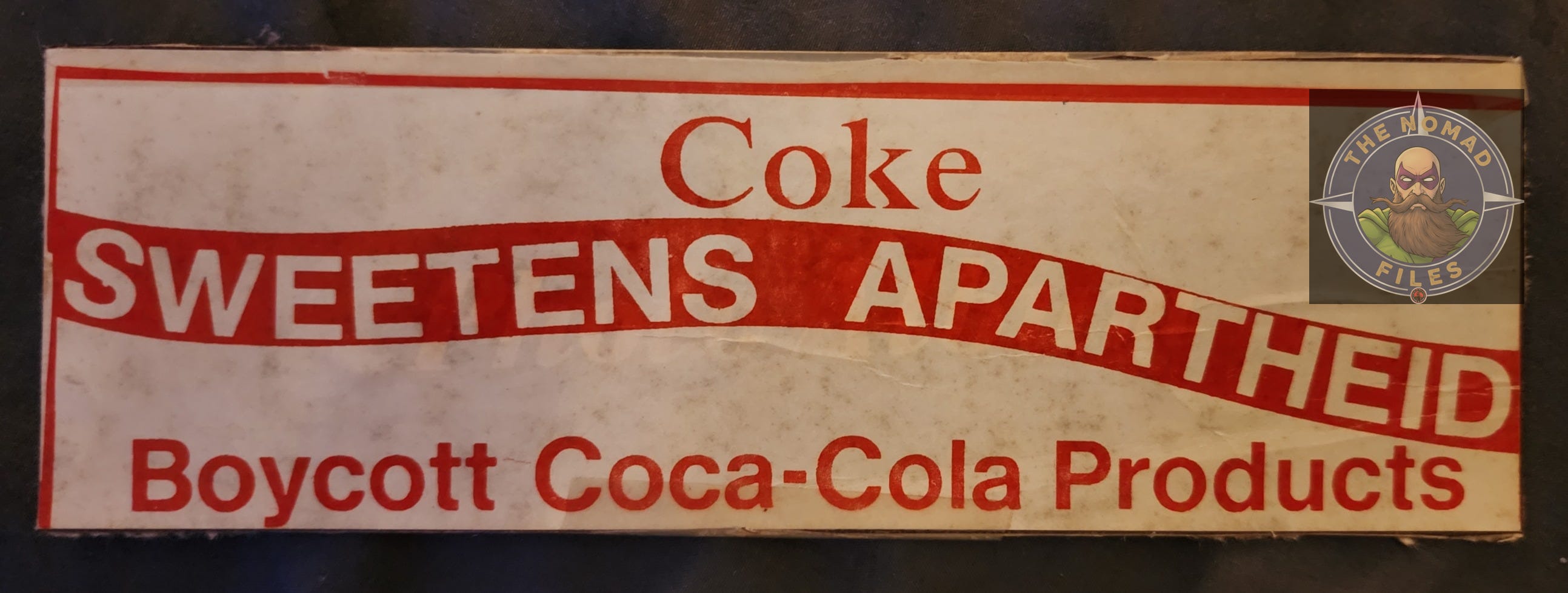
I found a piece of cardboard today, a relic of the “Good Ol Times”. Just a plank of refuse, really, but it’s holding onto 1984 with the kind of stubborn grip that only cheap adhesive and righteous anger can manage.
It’s my first political sticker. “Coke Sweetens Apartheid.”
Looking at it now, peeling at the edges, it’s not just a piece of ephemera. It’s a time machine. It’s proof of life. It’s the receipt for forty years spent in the trenches of the American Left.
It started on the steps of the Federal Building in Grand Rapids, Michigan. While other kids were worrying about Atari scores or Little League, I was shivering in a sleeping bag, occupying concrete to protest the death squads in El Salvador. Reagan was in the White House—an absolute piece of human garbage, by the way—and even at ten, the stench of imperialism was enough to wake you up.
But this sticker? This brings me back to the “Space.”
We had a spot in Eastown, right over by the food co-op. If you closed your eyes, you could navigate by the smell alone: rotting paperbacks, patchouli oil, and dissent. It was a perfect incubator for revolutionary thoughts, usually fueled by a chili dog, at Yesterdog, a good place to foment that revolution. There was a table center stage, groaning under the weight of the counter-culture starter pack: personal hygiene items, Statuettes of Liberty, and zines. God, the zines. We drowned in them.
That was where I met my first cohorts. And, of course, her.
I think her name was Alex. Or maybe it started with an A. It’s been forty years and a lot of drugs since then, so the details are hazy, but the feeling isn’t. She was in high school, which meant she was a goddess to me. We traveled to conferences around Michigan—overnight trips without my parents—and let’s just say my sleeping bag always found its way suspiciously close to hers.
It wasn’t just teenage hormones; it was the shared adrenaline of the “Line Crosser” training. We went to Wurtsmith Air Force Base to stare down the MX missiles they were railing around Michigan like a doomsday model train set. A disaster waiting to happen that didn’t even need a warhead to kill us.
I was trained in non-violent civil disobedience. I was taught to go limp. I was taught to be the “line crosser” who absorbs the blow but doesn’t return it.
My parents were radicals, absolutely. But they were radicals of a specific vintage—the kind who could blend sedition with community theater. They weren’t hiding their politics in the basement; they were performing them on stage and living them in the living room.
I realized just how different my upbringing was when I was thirteen. We were at a cast party—my folks were actors in a local play—and the room was thick with that specific theatrical energy: loud laughter, cheap wine, and the smell of burning herb.
I was sitting with a guy named Billy. He passed a joint my way. In any other household in Reagan’s America, this would be the moment of teenage rebellion, the secret transgression you hide from the authority figures. But I didn’t hide it. I walked right up to my folks, in the middle of the party, and asked for permission.
And they gave it.
”Go ahead,” they said. No clutching of pearls, no lecture. Just an acknowledgment that experience was something to be managed, not forbidden.
That was the world I was raised in—one where boundaries were fluid and “authority” was a dirty word. But looking back, I realize that even their radicalism had a certain optimism to it. They raised me in the glow of the post-60s belief that if you just showed up, linked arms, and sang loud enough, the walls would crumble.
I think that’s where we diverged.
I was ten years old when the apple fell from the tree. And if you’re wondering—yes, the apple fell extremely close to the trunk, but then it rolled down a hill, gathered speed, and arguably landed further left than the tree ever stood. I’ve spent the last forty years watching the things they protested against—imperialism, corporate greed, the war machine—metastasize into something far uglier than they could have imagined in 1985.
They gave me the foundation. They taught me to question everything, to occupy the space, to be the “line crosser.” But somewhere between the grunge scene in Seattle and thirty-five years in professional kitchens—seeing the absolute worst of capitalism’s meat grinder up close—my politics hardened.
My parents’ radicalism was about correction; they wanted to fix the system. My radicalism, the kind that has calcified in my chest after four decades, suspects the system is unfixable. They were content to cross the line and get arrested to make a point. Me? I’m looking at the line, and the fascists on the other side of it, and I’m realizing that simply “crossing” it might not be enough anymore.
I love them for the path they cut for me. But I think I’ve walked to the end of their map and started drawing my own. And on my map, the dragons aren’t theoretical.
Forty years a radical. And I’ve still got the sticker to prove it.